Book call





Techytrion
Techytrion
 30, Oct 2026
 Artificial Intelligence
Artificial intelligence has moved far beyond chatbots that answer questions. In 2026, businesses are adopting AI agents, smart systems that can plan, decide and complete tasks on their own. This new approach is called agentic AI, and it is changing how companies handle customer support, sales, operations and software development.
In this guide, we explain what AI agents are, how they work, where they deliver real value, and how your business can start using them safely.
What Are AI Agents?
An AI agent is a software system that can understand a goal, break it into steps, use tools and take action to achieve that goal, with little or no human help at each step.
A regular AI chatbot waits for your question and gives an answer. An AI agent goes further. If you say, “Follow up with every lead who has not replied this week,” the agent can check your CRM, write personalised emails, send them, and log the results.
In simple words: a chatbot talks, an AI agent works.
What Is Agentic AI?
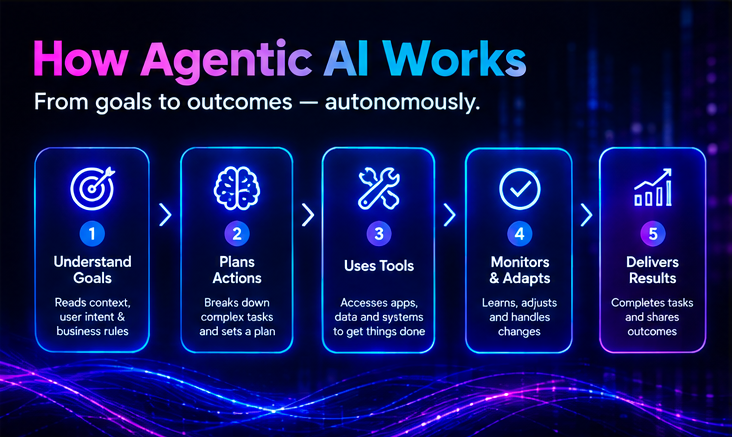
Agentic AI is the approach of building AI systems that act with a degree of independence. Instead of producing one output per prompt, agentic systems:
- Set and follow goals
- Plan multi-step tasks
- Use external tools such as email, databases, APIs and calendars
- Learn from results and adjust their next move
- Ask a human for approval when a decision is risky
This is why agentic AI is often described as the shift from AI that assists to AI that acts.
How Do AI Agents Work?
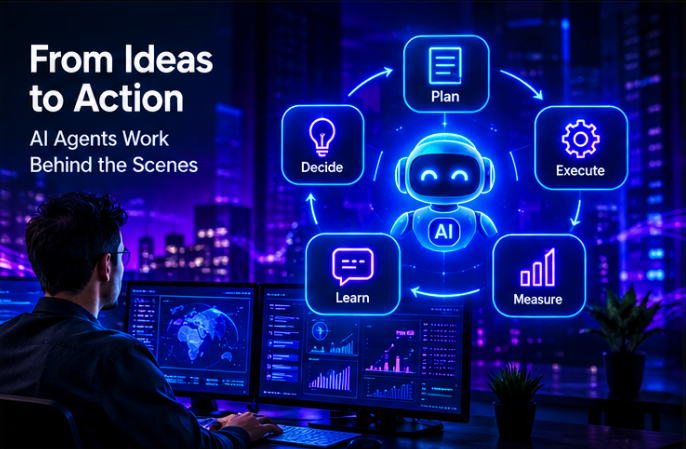
Most AI agents follow a simple loop:
- Perceive: The agent receives a goal, message or trigger, such as a new customer email.
- Think and plan: A large language model (LLM) breaks the goal into smaller steps.
- Act: The agent uses tools to carry out the steps, such as searching a database, sending an email or updating a record.
- Check: It reviews the result and decides if the goal is complete.
- Improve: It adjusts the approach, or asks a human for help if it is stuck.
Behind the scenes, an agent usually combines an LLM, a memory of past context, access to your business tools, and clear rules about what it is and is not allowed to do.
Build or Buy: Custom AI Agents vs Ready-Made Tools
Ready-made AI tools are quick to launch and work well for general tasks. However, if your workflow is unique, or you need deep integration with your own software, a custom AI agent is often the better long-term choice. Custom solutions can be tailored to your data, your processes and your security requirements.
A good IT partner can help you decide which route is right, design the architecture, build the integrations and keep the system secure.
The Future of AI Agents in Business
Agentic AI is still evolving, but the direction is clear. Businesses will increasingly use teams of specialised agents that work together, one for research, one for writing, one for data and one for customer communication, supervised by people. Companies that start learning and experimenting now will be better prepared as the technology matures.
Conclusion
AI agents and agentic AI are moving businesses from simply using AI to working with AI. By automating routine tasks, responding faster and supporting better decisions, agents can help companies save time, reduce costs and grow. The best approach is to start small, set clear guardrails, measure results and scale step by step.