Book call
🌐 How Generative AI Is Revolutionizing Software Development and Data Analytics
The digital landscape is undergoing one of its most significant shifts yet, with generative AI leading the way. Generative AI has progressed from producing text, images, and video to fundamentally altering how we develop code, process data, and make decisions, going beyond the revolutionary aspects of impact and productivity. In the new world of generative AI, it will not simply be a tool to help improve
productivity, but will act as a collaborator, co-pilot, and driver of innovation.
Let us look at how Disruption is changing two of the most important pillars of the technology world: software development and data analytics.
Part 1: Software Development – From Writing Code to Engineering Intelligence
Software development has traditionally relied on both a craft and a science, requiring extensive logic, long hours, attention to details, and complete focus. Developers will no longer be starting with a blank canvas given new generative AI tools can now act as a co-pilot and co-developer with context-aware prompts, code generation, suggest optimizations, and help obstain errors.
💡 Key Transformations in Software Development:
1. AI as a co-developer
With tools like GitHub Co-Pilot and Amazon CodeWhisperer powered by large language models, they will suggest whole lines, or blocks of code. Code known to be well trained from open-source code warehouses enables AI co-developers to produce accurate, quality contextual suggestions.
2. Increased productivity
By greatly reducing time spent on mundane tasks: logging into an app or correcting mistakes in API code, developers will be able to focus on the important aspects of applications, especially core logic, system design, and user experience. Applications will be developed faster and allow better quality to those applications.
3. Automated Testing and Debugging
Generative AI tools can detect bugs, develop test cases and suggest fixes. Generative AI will detect errors on the frontend and backend, speeding-up the QA process and should reduce the quality management burden on QA groups.
4. Democratizing Development
Development for all because of the implementation and growth of natural-language to code tools all persons will be able to develop a simple application, opening the door to all product managers, and software will be available to everybody.
5. Smart Documentation
AI tools have now reached the point where they can auto-generate documentation based on code comments, commit messages, and utilization patterns. This allows teams to maintain cleaner, better-documented code bases, which has tremendous value in agile and fast-paced environments.
📈 Part 2: Data Analytics – From Data Crunching to Data Conversations
Time has always been the enemy of data analytics, and analysts often spend 80% of their time cleaning, shaping, and organizing data – leaving only a fraction of their time dedicated to extracting meaningful insights. Enter Generative AI! It’s changing the way organizations approach data and moving them away from purely reactive dashboards to proactive bi conversational intelligence.
📊 Key Evolutions in Data Analytics:
1. Conversational BI (Business Intelligence):
Generative AI allows users to interact with their data using natural language queries. For instance, you could say, “What were our top 5 revenue-generating products in Q2?” and the natural language query could produce a visualized response within seconds.
2. Automated Report Generation:
AI can now produce full reports that include summaries, visuals, and trending data based on data found within CRMs, ERPs, and custom dashboards. If leadership requires needing to make informed decisions, AI can provide full reports quickly and easily.
3. Predictive & Prescriptive Insights:
Generative AI has the capabilities to not just report on what happened in the past, but forecast what trends, or anomalies might occur based on historical data and in fact to be prescriptive in terms of suggesting future actions based on data – moving analytics from descriptive to predictive and prescriptive.
4. Faster Data Preparation:
Data cleaning, transformation, and enrichment, historically the most tedious aspect of an analyst’s job, is now getting burned down by AI models that are trained to recognize patterns, identify errors, and ultimately recommend the ideal data structure for their use case.
5. Accessibility to Non-Analysts:
More easily bringing Raw Data to BI solutions with much more useful, faster, and flexible interactive desktop applications/connected apps and then a user-friendly Report/BI tool with intuitive interfaces for thousands of decisions is finally at a place where non-analysts can become analysts! More easily bringing raw data to BI solutions with much useful, faster and flexible interactive
🔄 When Software and Analytics Merge: The True Power of AI
The true magic occurs when generative AI convergences with software and data analytics.
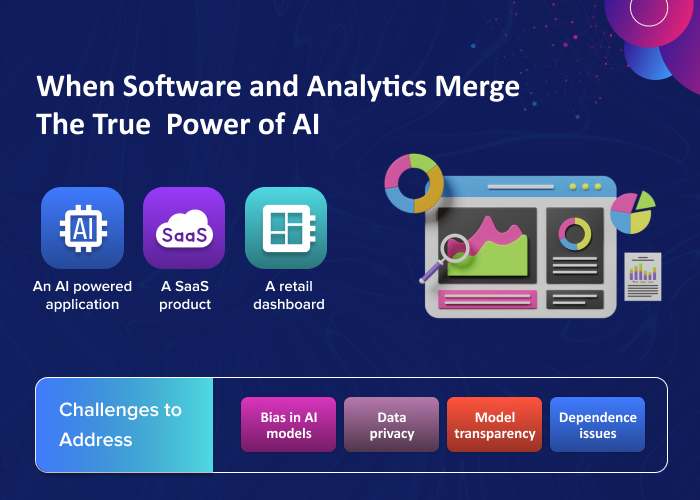
Imagine:
✅ An AI powered application that processes transactions and tracks users to suggest UX improvements based on usage data.
✅ A SaaS product that automatically generates personalized performance summaries for each person on a team as informed by CRM metrics.
✅ A retail dashboard that combines live sales data with seasonal patterns and social sentiment, and suggests actions for inventory. Welcome to the age of AI-native systems—platforms that do not just act on human input, but mechanize learning, action, and adaptation.
🚧 Challenges to Address
Of course, with great power comes great responsibility. As the organizations begin to use generative AI, they will need to think about:
Bias in AI models: Ethical and responsible use of AI will require continual checking of outputs and even the training data.
Data privacy: Generative AI will need to comply with global data and privacy laws and regulations, including GDPR, HIPAA etc.
Model transparency: Knowing how the AI came to its decision (model explainability) is imperative for high-stakes uses.
Dependence issues: Teams will need to be aware about unquestioning reliance on code or insights generated by AI with our human minds.
🌍 The Road Ahead
For better, generative AI is still rapidly maturing, and we can already see:
AI copilots embedded in our IDEs, BI tools, and business apps.
Models that are vertically-specific that are pre-trained for use in healthcare, finance, and education.
AI-assisted development life cycles – planning all the way through deploying including customer feedback loops.
But, this is just the beginning.
The future isn’t going to be built by AI alone, but from human beings who can utilize AI.
✨ Conclusion
Generative AI is not threatening developers or analysts—it’s a way to expand their potential. And, as we move forward with business as usual, those who are quick to adopt this technology will create unprecedented efficiencies, insights, and value. The experience of creation, analysis, and thought are beginning to merge, and at the center of it all is Generative AI—our most powerful collaborator yet.